

Many households in Western Europe have installed an air source heat pump, often replacing an existing gas, oil or pellet boiler.
After doing so, it is not uncommon to experience a large increase in the energy bill. Some of this can come from systems that are not set up and balanced properly.
However for many, time of use tariffs is an even larger contribution to the increase. Going from a fixed price per m3 to 2-3 tariffs per day, or even 15-60 minute price intervals, makes it almost impossible to do what is needed to keep your bill low.
To keep track of this, you need to look at electricity prices daily, and plan your heating accordingly by using built-in timer functions or manually adjusting the set temperature.There is also a persistent myth that if you pre-heat your home at low tariffs, the extra leakage will cause you to lose the gains by shifting power consumption.In this post, we’ll break down the economics of shifting energy use, and show how the Alva Link can help you automate it.
Did you know that your house is basically a large thermal battery?
Walls, floors, furniture and more all hold thermal energy. When you heat up the house, some energy is constantly leaking to the outside through walls and roof.
The by far largest part is still stored inside the house, and can be used to avoid running your heat pump or domestic hot water heater at the expensive time periods, instead letting your coast on energy already stored there.
For this blog post, we will use a simple model developed by UK-based Tom Waskett, from Tim & Kat’s Green Walk: https://www.youtube.com/watch?v=q1tYCenxb2M
The simplified scenario here assumes 3 tariffs during a winter day (0C) - night (low), midday+evening (medium) and afternoon (high).
For this scenario, we have set up 3 use cases:
- Constant 21C all day long
- Night saving - drop 10% in temperature during night
- Thermal battery - heat up house outside high tariff periods and “coast” price spikes
The spreadsheet used for the calculations is found here: https://docs.google.com/spreadsheets/d/1PVg02SXDEXrd2jkHRt9o7FnhotCRiTULBI61u_R_xnw/edit?gid=759268022
Optimisation and efficiency
An important aspect to not forget in the optimisation scenarios, is the heat pump efficiency (SCOP).
The efficiency (heat out in kWh / electricity input in kWh) is dependent on the temperature difference between the outdoor temperature and the temperature of the output water of the heat pump (typically 30-45C).
This means that during periods where we increase the indoor temp, the water temperature is increased, which negates some of the benefits.
To compensate for this, the model has reduced the average COP over the day for the two savings scenarios.
They are reduced by approx the same amount, because since the night save mode needs to heat up again much faster, the water output temp needs to be even higher during heating.
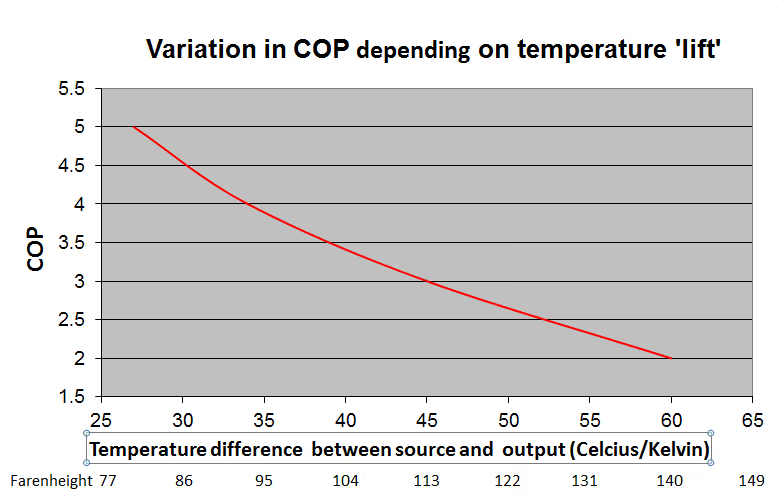
https://heatpumps.co.uk/heat-pump-information-without-the-hype/what-is-the-cop/
Constant temperature scenario
This scenario is pretty simple: Temperature set to 21C, all day long, regardless of price.
As you can see, there is just as much energy input during the high price periods as the lower ones. Maybe there are some savings potential here?

Night saving scenario
Night saving is a tempting method to attempt to save on the power bill. After all, the average temperature in the house is reduced, and no-one needs to experience the reduced comfort from cold temps in the house.
At first glance, the savings feel very intuitive. But in practice, you end up with net 0 savings!
There are two main reasons for this.
1) The average COP goes down, as you need to heat a lot in a short time to bring temperature back up again in time for morning. This is also the case
2) The energy savings happen mostly at night when tariffs are low. However, you still have to heat at nominal temp during the day and afternoon when the prices are the highest.

Thermal battery scenario
Contrasting night saving to the thermal battery scenario, there are several differences.
You add energy to the home “battery” during low tariff and let it slowly leak out during higher tariff periods.
The model does this twice, slowly filling the battery during night (to avoid too much of a COP hit) up to 2C higher than nominal temperature, and then releasing it again over the course of the day.
Before peak tariff in the afternoon, the same is done again. And in the evening, temperature drops slowly for a few hours to allow for comfortable sleeping temps.

Comparison
We have looked at three different scenarios in the article. The two most common models in use are constant temperature and night saving.
However, comparing these with using the house as a thermal battery, shows that there can be a lot to save in the winter when the electricity price spikes during day and afternoon.
To sum it up - the 24hr relative cost in the three scenarios used in this study is:
Constant temperature 21C: 100%
Night saving -2C: 100%
Thermal battery +0-2C: 80%
Looking at the net savings in this scenario, as much as 20% is saved by using your house as a thermal battery during winter. These savings are also for the coldest months when most energy is used.
Savings can be even higher if you factor in adding extra heat to the domestic hot water boiler during low tariff periods!
So why isn't everyone doing this?
Talking to heat pump owners lately, we have seen that there are several myths that are typical barriers to achieve these savings:
- Fear of reduced comfort: If you look at the temperature curve, you will see that the temperature is actually higher when you are awake than in other scenarios
- No savings: Clearly not the case when you go to 3 or more tariffs a day with larger intra day changes- savings are often highest when hourly based pricing and huge spikes come into play on winter days with no wind or sun.
- Too much work: Manual follow up and tuning daily, or programming and setting up tools like Home Assistant
- You can achieve the same with a home battery: This is true, until you factor in a depreciation cost of 50-100cent per kWh discharge from the lifespan of the battery.
All these barriers are now being removed - with equipment like Alva Link that can do this automatically for you.
The only experienced difference is that during periods of the day, the house becomes more comfortable.
Alva Link also makes it possible to extend the system by integrating P1 / HAN port smart meter readers to avoid peak tariff penalties.
The system can then also direct any surplus energy during summer into hot water, your EV or a house battery to save even more.
Read more and sign up on the wait list at https://alva.as
If you want to test out the model for yourself - make a copy of the document below and play around with it!
https://docs.google.com/spreadsheets/d/1PVg02SXDEXrd2jkHRt9o7FnhotCRiTULBI61u_R_xnw/edit?gid=759268022
Other links:
- https://heatpumps.co.uk/heat-pump-information-without-the-hype/what-is-the-cop/
- https://www.spiritenergy.co.uk/kb-battery-storage-for-solar-residential-economics
