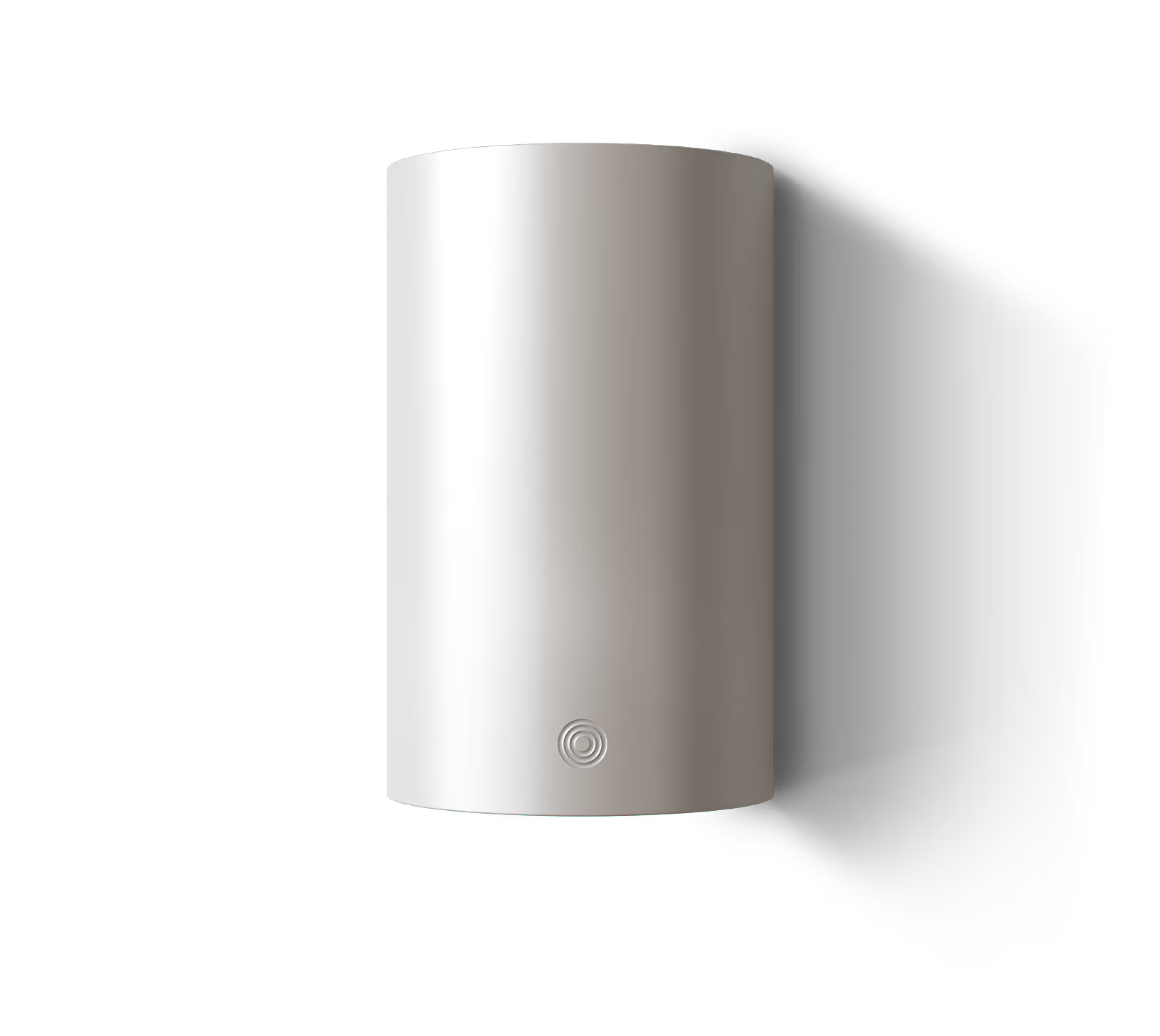
Why does Alva LINK use 2.4 GHz Wi-Fi instead of 5 GHz?
Because Alva LINK is designed to be mounted near energy hardware — inside utility closets, beside fuse boxes, next to heat pump controllers — not on a living room shelf. 2.4 GHz was chosen deliberately for its superior range and signal penetration in these environments.
The physics: Wi-Fi operates on two primary frequency bands. 5 GHz offers higher throughput (useful for video streaming and large file transfers) but suffers significantly higher signal attenuation through building materials. 2.4 GHz has roughly twice the effective range and penetrates concrete, brick, and metal enclosures far more reliably. The attenuation difference is not marginal — at 5 GHz, a single concrete wall can reduce signal strength by 15–25 dB, while the same wall attenuates 2.4 GHz by only 8–15 dB. In a typical European home where the technical room may be separated from the router by two concrete walls and a floor, that difference determines whether the device stays connected or drops offline.
Why throughput doesn't matter here: Alva LINK's cloud traffic is extremely lightweight — small JSON payloads containing price forecasts, weather data, and optimization schedules. A typical data exchange is under 10 KB. The device does not stream video, transfer files, or handle high-bandwidth media. Even at the lowest 2.4 GHz data rates, Alva LINK has orders of magnitude more bandwidth than it needs. What it requires is reliable connectivity and low packet loss, not throughput — and 2.4 GHz delivers exactly that in the installation environments where Link lives.
Latency is not a concern either. Alva LINK's optimization decisions are calculated locally on the device processor. The cloud connection delivers forecasts and updates, not real-time control signals. If cloud latency spikes by 500 ms — or even if the connection drops entirely for hours — the on-device optimization engine continues operating from its last known schedule. No control decision depends on round-trip cloud latency.
Compatibility advantage: Every Wi-Fi router sold in the last 20 years supports 2.4 GHz. Not all support 5 GHz on all channels, and mesh networks occasionally steer 5 GHz devices in ways that cause intermittent drops. By using 2.4 GHz exclusively, Alva LINK avoids the band-steering and channel-selection issues that cause connectivity headaches with competitors like Homey's Energy Dongle (which fails silently on 5 GHz networks) and tado° (which relies on WPS pairing within a 5-metre range).
Technical note: Alva LINK is built on a chip, which includes 5 GHz Wi-Fi capability at the hardware level. The current firmware uses 802.11 b/g/n on 2.4 GHz — the right choice for the installation environments described above. If for some reason anyone wants to do 5 GHz, support is on our roadmap and may be enabled in a future over-the-air firmware update, though we're not committing to a timeline. Bluetooth Low Energy (BLE) handles initial device discovery and setup, ensuring the onboarding flow works even before Wi-Fi credentials are configured. After setup, BLE remains available for local diagnostics.
Meet the device that runs your home smarter